

Where to Find Affordable Wall Art for a Neutral Living Room
Last Updated: November 12, 2026
Quick Summary
The cheapest places to find affordable wall art for a neutral living room are online print-on-demand shops, which sell unframed prints you can frame yourself. Homeware retailers offer ready-made framed prints, while charity shops and downloadable art files give further low-cost options.
- Unframed prints from UK print-on-demand services are often the lowest-cost entry point.
- Ready-made framed prints are fastest, but offer a narrower choice of size and frame.
- Compare the full cost, including frame, mount and delivery, not just the print price.
- Above a sofa, size the art to about two-thirds of the sofa's width.
- Hang the centre of the art at roughly 150 to 160 centimetres from the floor.
Table of Contents
- Why a Neutral Living Room Needs the Right Wall Art
- Where to Find Affordable Wall Art in the UK
- Choosing Art for a Neutral Living Room Palette
- How to Style Neutral Wall Art So It Looks Intentional
- Sizing and Placement for Neutral Walls
- Budget-Friendly Gallery Wall Ideas
- Choosing Your Next Piece for Your Living Room
- Frequently Asked Questions
Why a Neutral Living Room Needs the Right Wall Art
A neutral living room can look flat if the walls carry nothing of interest. Many people who have painted in cream, ivory or soft beige struggle to decide what goes above the sofa. The right piece of affordable wall art brings warmth and character without breaking the calm palette.
Neutral schemes work because they let texture, shape and tone do the talking. A single print in a warm tone can anchor the room. A gallery of framed prints can add depth. The aim is to add personality, not noise.
Budget is often the main constraint. Many people assume quality art costs a great deal, but there are more affordable routes than most expect.
Where to Find Affordable Wall Art in the UK
Choosing a source depends on how much you want to spend, how quickly you need the piece, and how much choice you want over size and frame. Prices vary by retailer, print size and frame finish, so compare the total price rather than the print alone. The most useful approach is to sort UK sources into a few clear tiers, then weigh the full cost of each route.
The main UK routes, ranked by entry cost
1. Unframed prints from online print-on-demand shops. These are usually the cheapest entry point.
2. Ready-made framed prints from homeware retailers. High-street and online homeware chains sell framed prints in standard sizes, and prices vary by retailer, size and frame.
**3.
4. Second-hand and charity finds. Charity shops, car boot sales and online marketplaces regularly turn up framed prints, vintage posters and original canvases at low prices.
5. Canvas prints. Canvas is often marketed as a budget option, but its total cost depends on size and finish, so compare it with other routes.
What to compare before you buy
- Base print price: the cost of the print alone, in the size you need.
- Frame and mount: a basic frame can change the total significantly; a mount adds another cost but makes a small print look more considered.
- Delivery: some retailers charge per item, others offer a threshold for free delivery. Factor this in for multi-piece gallery walls.
- Paper and print quality: a thin paper may look fine online but feel flimsy on the wall. Look for paper weight in grams per square metre (gsm) where stated.
- Returns: check whether damaged or unsuitable prints can be sent back, and who pays return postage.
For the most accurate picture, check current prices on each retailer's website before you decide. Prices and delivery terms can change, so check current pricing on each retailer's website before deciding.
Ready-made framed art versus printing your own
Ready-made framed art is convenient. It arrives ready to hang, and the frame is chosen for you. The trade-off is less control over size and finish.
Printing your own gives more flexibility. You can choose the image, the paper and the size, then pair it with a frame you already own or buy separately. This route suits people with a particular image in mind or a spare frame.
A practical approach is to buy a good-quality print and source a simple frame in a matching neutral tone. That combination often gives a more considered result than a ready-made set at a similar total cost.
The full-cost view
The sticker price is rarely the whole story. A print that looks cheap can cost more once a frame, mount and delivery are added. Before you buy, add up the print, frame, mount and delivery, then compare that total against a ready-made framed piece in the same size. For a gallery wall, multiply by the number of pieces and check whether the retailer's delivery threshold makes a single larger order cheaper than several small ones.
The table below sets out the main UK routes, with the trade-off for each, so you can weigh cost against convenience.
| Route | Best for | Key difference |
|---|---|---|
| Unframed print-on-demand | Lowest entry cost | You buy the frame separately |
| Ready-made framed homeware | Fastest, ready to hang | Narrower choice of size and frame |
| Downloadable art files | Specific image, own frame | You pay for file, then printing |
| Second-hand and charity | Lowest prices | Size and subject cannot be chosen |
| Canvas prints | Texture, no glazing | Harder to clean and swap |
Choosing Art for a Neutral Living Room Palette
A neutral palette leaves plenty of room for choice. The key is to pick pieces whose colours sit within the room's tones rather than fighting them.
Start with the walls, sofa and rug. Note whether the undertones lean warm (cream, ivory, caramel) or cool (grey, greige). Choose art that echoes one or two of those tones. A warm sand print will sit comfortably with cream walls.
Natural hues, such as muted greens, soft terracotta or washed blue, can add interest without breaking the scheme. Avoid pieces with strong primary colours unless you want them to be the focal point.
Texture mattrs too. Linen-look canvas prints, matte posters and natural wood frames all add tactile interest to a calm room.
How to Style Neutral Wall Art So It Looks Intentional
A common mistake is hanging a single small print in the middle of a large wall. It can look like an afterthought. Either go larger or group pieces together.
Consider these styling approaches:
- One large statement piece: works well above a sofa or fireplace.
- Matching frames: a set of prints in the same frame finish looks cohesive.
- Mixed frames: pair two or three finishes in the same tone family, such as natural oak and cream.
- Vertical or horizontal balance: alternate orientations to keep the arrangement lively.
Watch out: mixing too many colours or styles on one wall often makes a neutral room feel busy rather than calm. Keep the palette tight, and let the art do the work.
Sizing and Placement for Neutral Walls
Sizing is one of the most useful things to get right, and it is where most neutral-room art goes wrong. A piece that is too small leaves the wall looking empty; a piece that is too large crowds the furniture. The guidance below turns the rough ratios into a measuring method you can use before you buy.
Measure the wall and the furniture first
Start with the width of the furniture the art will sit above, such as a sofa or console. As a rough guide, a piece above a sofa should be about two-thirds the width of the sofa. A piece on a smaller wall should fill roughly half to two-thirds of the wall's width.
Measure the height of the wall from the top of the skirting to the ceiling, then note where the furniture sits. This tells you how much vertical space you have and whether a portrait or landscape orientation will fit better.
Use standard UK frame sizes
Most affordable frames in the UK come in a small set of standard sizes, which makes shopping easier and framing cheaper. Common sizes include A4 (210 × 297 mm), A3 (297 × 420 mm), A2 (420 × 594 mm) and the imperial sizes 8 × 10 inches, 12 × 16 inches and 16 × 20 inches. Buying a print in a standard size can make it easier to swap frames later. Watch out: a print sold in centimetres may not fit an inch-based frame exactly, so check the internal frame dimensions rather than the external ones.
Work out the hanging height
Hang artwork so the centre sits at about eye level, roughly 150 to 160 centimetres from the floor. Above furniture, leave a gap of around 15 to 20 centimetres between the bottom of the frame and the top of the sofa or console. In a room with high ceilings, you can raise the centre slightly, but keep the gap above the furniture consistent across the wall so the pieces read as a group.
Test the layout before you drill
Measure before you buy. Mark the dimensions with painter's tape on the wall to see how the piece will look before you commit to a hole. For a single piece, mark the outer edges and the centre point. For a gallery wall, cut paper templates to the size of each frame, tape them to the wall and adjust the spacing until the arrangement feels balanced. Keep gaps between frames consistent, usually 5 to 8 centimetres.
Choose the right fixing for the wall
UK homes commonly have plasterboard, brick or cavity walls, and the fixing matters as much as the position. A heavy framed print on plasterboard needs a cavity fixing rather than a plain nail; a brick wall can take a screw and plug. Check the weight of the framed piece against the fixing's rating before hanging. If you rent, use removable adhesive hooks for lighter pieces and patch the holes before you move out.
Placement by room layout
- Above the sofa: centre the piece or group on the sofa, not the wall, so it reads as connected to the furniture.
- On a chimney breast: treat the breast as its own wall and size the art to it rather than the full room width.
- In a narrow alcove: a single portrait piece or a vertical stack of two prints uses the height without crowding the sides.
- Opposite a window: expect glare on glazed frames; a matt print or canvas reduces reflections in a bright neutral room.
Budget-Friendly Gallery Wall Ideas
A gallery wall is one of the most effective ways to add interest to a neutral room on a budget. Combining several affordable prints gives more impact than one expensive piece.
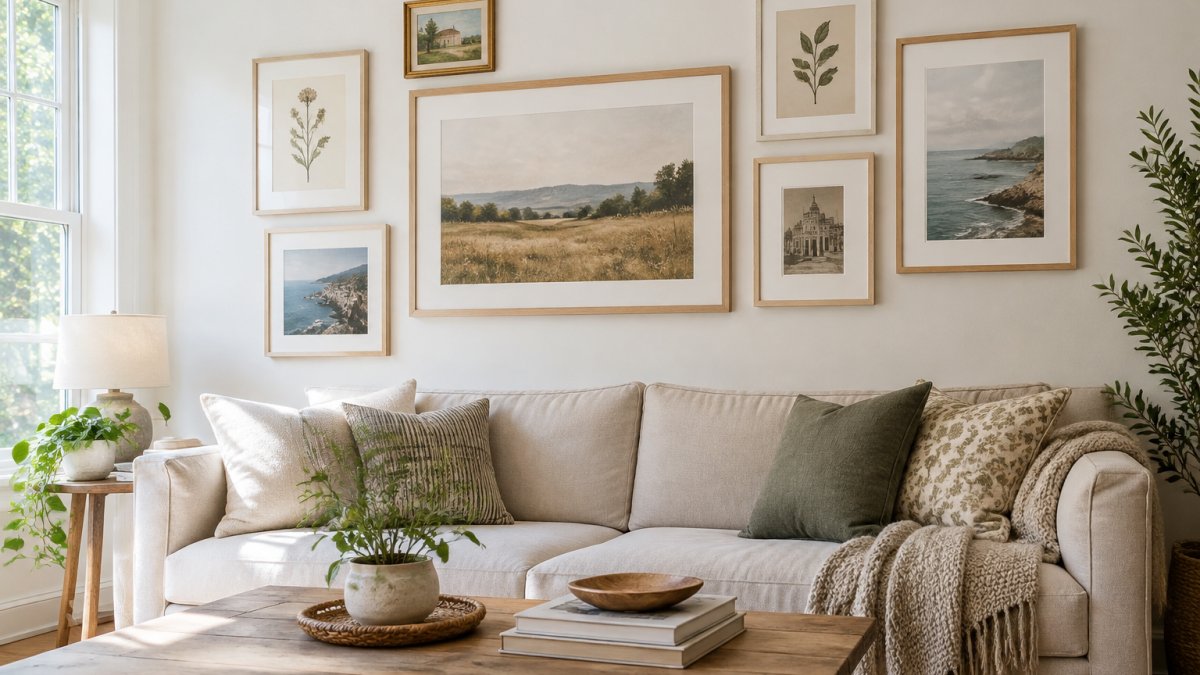
Lay the pieces out on the floor first. Move them until the spacing feels balanced, then transfer the layout to the wall. Keep gaps between frames consistent, usually 5 to 8 centimetres.
Mix sizes for variety, but keep a consistent frame tone. Use a mix of prints, posters and framed textiles if you want a softer look. Start small and add pieces over time as your budget allows.
Choosing Your Next Piece for Your Living Room
Once you have chosen a style, palette and size, the final step is choosing the piece itself. Yellow Rose Living offers curated home decor for living spaces, and you can browse the collection to find artwork that suits a neutral room. For current prices, delivery options and availability, check the Yellow Rose Living website before you order.
Frequently Asked Questions
How do you choose wall art for a neutral living room?
Start with the dominant tones already in the room, such as cream walls, oatmeal rugs or pale oak furniture, and pick art that repeats one of those colours. Choose either a tonal piece that sits quietly against the walls or a single accent colour, such as sage or terracotta, used in small amounts. Scale mattrs as much as colour: a large piece above a sofa usually works better than several small ones scattered around. Check the print's colours against your room in daylight before ordering, since screens often show creams and greys differently from how they look on the wall.
What types of art work best in a neutral colour scheme?
Abstract prints in soft earth tones, botanical line drawings, black and white photography and minimalist landscapes all suit neutral rooms well. These styles add texture and interest without competing with the palette. Framed prints in natural wood or thin black frames tend to look the most cohesive. Canvas prints work well in larger sizes where you want a softer, less formal finish, while paper prints under glass suit smaller pieces grouped together.
Where can I buy affordable framed prints in the UK?
Several UK online print shops and homeware retailers sell framed prints at a range of price points, and it is worth comparing the total cost rather than the print price alone. Add the frame, delivery and any mounting hardware before deciding. For current prices and available sizes, check Yellow Rose Living's website directly.
How do I create a gallery wall on a budget?
Mix a few higher-impact pieces with smaller, inexpensive prints so you are not buying every frame at full price. Use matching frames in one finish, such as thin black or natural oak, to unify pieces bought from different sources. Lay the arrangement out on the floor first, keeping gaps between frames to roughly 5 to 8 centimetres, then transfer it to the wall. Printing your own images or using good-quality posters in cheap frames can cut costs further while still looking deliberate.
